Changing careers is no longer unusual. In a fast-changing job market, many professionals reassess their goals and look for new opportunities.
Courses play a key role in this transition. They provide structure, practical skills, and confidence to move into a new field.
Choosing the right course can shorten the learning curve and reduce the risks involved in a career change.
Why Career Transitions Are More Common Today
Technology, automation, and remote work have reshaped many industries. Some roles disappear, while new ones emerge quickly.
At the same time, people seek more meaningful work, better work-life balance, or higher income potential.
Courses allow professionals to adapt without starting from zero or returning to full-time education.
The Role of Courses in Career Changes
Courses offer focused learning. Unlike traditional degrees, they target specific skills required by the market.
They also allow flexibility. Many courses are online and self-paced, making them accessible to working professionals.
Most importantly, courses help bridge the gap between experience and new career requirements.
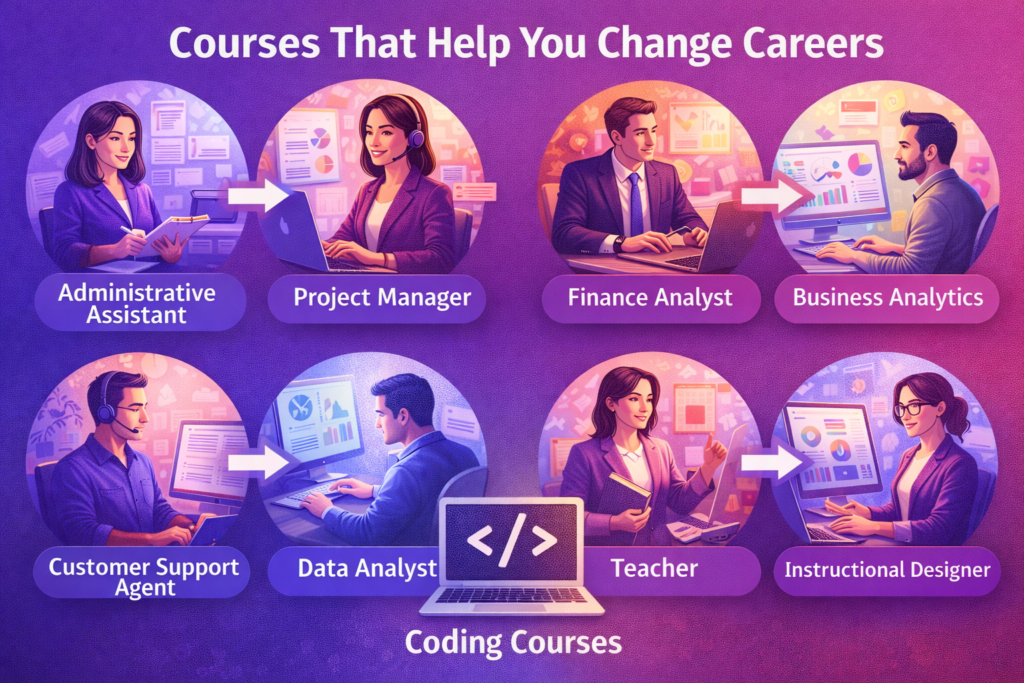
Transition From Administrative Roles to Project Management
Many professionals working in administrative or coordination roles already manage tasks, schedules, and communication.
Project management courses formalize these skills. They teach methodologies, tools, and frameworks used across industries.
For example, an office administrator can transition into a junior project manager after completing a project management certification and gaining hands-on practice.
Moving From Customer Service to Data Analysis
Customer service professionals develop strong problem-solving and communication skills. These abilities are valuable in analytical roles.
Data analysis courses teach technical skills such as spreadsheets, SQL, and data visualization tools.
A customer support agent can move into an entry-level data analyst role by combining analytical training with real-world business understanding.
Shifting From Marketing to UX Design
Marketing professionals understand user behavior, branding, and communication. These insights are highly relevant to user experience design.
UX design courses focus on research methods, wireframing, usability testing, and design thinking.
A digital marketer can transition into UX design by building a portfolio through course projects and real use cases.
Transition From Teaching to Instructional Design
Teachers already know how people learn. This makes instructional design a natural transition.
Instructional design courses teach how to create digital learning experiences, corporate training, and online courses.
Many educators move into corporate or freelance instructional design roles by applying their teaching experience in new formats.
Moving From Finance to Business Analytics
Finance professionals work with numbers, reports, and forecasts. These skills translate well into business analytics.
Business analytics courses expand technical knowledge in data tools and statistical analysis.
With targeted training, a financial analyst can transition into a broader analytics role focused on strategic decision-making.
Transition From Retail to Digital Sales or E-commerce
Retail workers develop sales techniques, customer interaction skills, and product knowledge.
Courses in digital sales, e-commerce platforms, and online marketing help transfer these skills to digital environments.
A retail salesperson can move into an e-commerce coordinator or digital sales role with the right training.
Technical Transitions Through Coding Courses
Coding courses are among the most popular options for career changers.
Professionals from fields like journalism, design, or engineering often transition into software development or web development.
These courses focus on practical projects, enabling learners to demonstrate skills even without prior technical backgrounds.
The Importance of Practical Projects
Courses that include hands-on projects are especially valuable. They allow learners to apply concepts immediately.
Projects also help build portfolios, which are essential during career transitions.
Employers often value demonstrated skills over formal titles when evaluating career changers.
Choosing the Right Course for Your Transition
Not all courses are equally effective. The best ones align with market demand and realistic job opportunities.
Look for courses that focus on practical skills, updated content, and clear learning outcomes.
Mentorship, community access, and career support can significantly improve transition success.
Managing Expectations During a Career Change
Career transitions take time. Completing a course does not guarantee immediate results.
Entry-level positions or transitional roles may be necessary steps.
Patience and consistency are essential to turn new skills into long-term career growth.
Combining Existing Experience With New Skills
The most successful career changes build on existing strengths.
Courses should complement what you already know, not erase your professional history.
This combination creates a unique profile that can be attractive to employers.
Conclusion
Courses play a powerful role in helping professionals change careers. They provide direction, confidence, and practical skills.
From administrative roles to project management, from teaching to instructional design, career transitions are achievable with the right learning path.
The key is choosing courses that align with your goals and leveraging your existing experience. With planning and commitment, a career change becomes not just possible, but sustainable and rewarding.